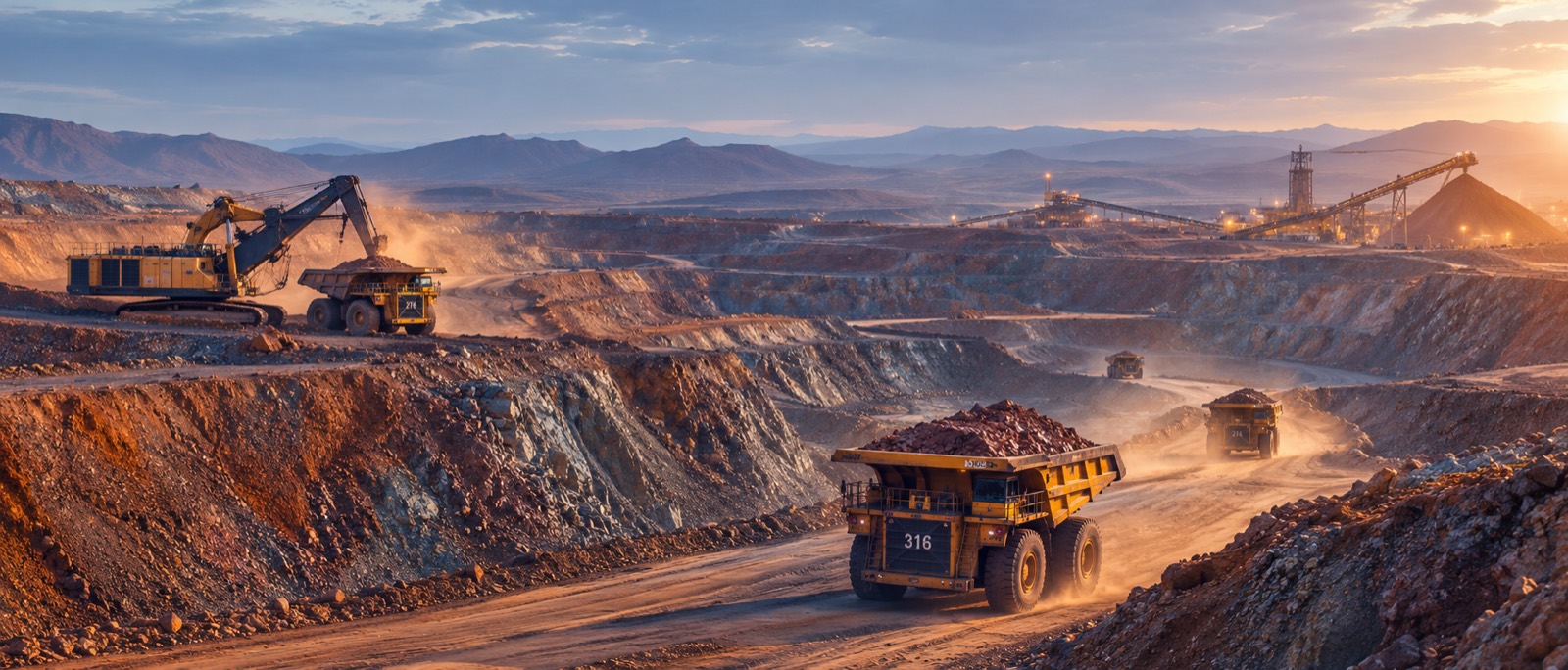
Mining joint ventures in Australia.
Australia is one of the few places where world-class geology sits inside a stable legal system with a mature, well-tested joint venture framework. For an investor who wants exposure to iron ore, copper, gold, lithium or manganese without building a mine from scratch, a farm-in or JV with an established tenement holder is usually the most efficient way in.
CommoFlow works with investors entering Australian mining projects and with tenement holders seeking a joint venture partner — identifying opportunities, structuring the farm-in or JV participation, guiding foreign investment approval and due diligence, and putting our trading and logistics desk behind the production once it flows.
Four ways into an Australian project
The structure you choose determines your tax position, your liability, whether you control operations, and whether you receive cash or physical product.
Farm-in / earn-in agreements
The most common way to enter an Australian mining project. The incoming party earns a defined percentage by funding exploration or development to an agreed amount over an agreed period — often staged, for example earning 51% by spending a set sum across three years, then a further tranche by delivering a feasibility study. Capital goes into the ground rather than to the vendor, which is why tenement holders favour it.
Unincorporated joint ventures (UJV)
The traditional structure for Australian mining. Each participant holds a direct legal interest in the tenements and takes its share of production in kind, rather than owning shares in a company. Participants account for their own share of costs and depreciation, which is why it remains popular for resource projects. Governed by a JV agreement with a management committee and an appointed manager.
Incorporated joint ventures (IJV)
A separate company holds the project, with participants as shareholders under a shareholders agreement. Cleaner for outside financing, limited liability and eventual sale of a stake, but less flexible on tax and on taking product in kind. Frequently the preferred structure where an offshore investor wants a clearly ring-fenced vehicle.
Offtake-linked participation
Rather than buying equity outright, an offtake agreement — sometimes with a prepayment — secures the production while leaving operatorship with the local partner. For a trading house this is often the most efficient route to the tonnes, and it can sit alongside a minority equity position.
The clauses that actually decide the outcome
Australian mining JV agreements are heavily precedented, which makes them look routine. The economics live in a handful of provisions.
Sole risk and dilution
What happens when one participant declines to fund a programme. Australian JV agreements typically allow the funding party to proceed at sole risk, with the non-contributing party diluted by an agreed formula — and often converting to a royalty below a threshold. This clause decides who ends up controlling the project.
Manager and management committee
Who operates, what they can spend without approval, how votes are weighted, and how deadlocks break. Operatorship is worth more than a few percentage points of equity.
Pre-emptive rights
First right of refusal if a participant sells its interest. Standard, but the mechanics and timelines vary widely and affect your exit.
Cross-charge and security
Participants usually grant each other security over their JV interest for unpaid contributions. Check how this interacts with any project finance you plan to raise.
Tenement conditions
Minimum expenditure commitments and reporting obligations attach to the tenement itself. Failing them risks forfeiture regardless of what the JV agreement says.
Native title and heritage obligations
Existing agreements with Traditional Owners transfer with the project and bind the JV. Understand them before you commit, not after.
The approval path
Foreign investment review
Acquisitions of Australian land and mining interests by foreign persons are reviewed by the Foreign Investment Review Board. Thresholds depend on the investor's country and the asset; foreign government investors are reviewable regardless of value, and critical minerals attract closer examination. Build the timetable around it from day one.
Native title and heritage
Most tenement grants engage the right-to-negotiate process under the Native Title Act 1993, and projects commonly operate under an Indigenous Land Use Agreement. Separate Aboriginal cultural heritage obligations apply at state level. These agreements bind the joint venture and are a primary driver of project timelines.
Tenements are state-administered
Mining is regulated by the states and territories, each with its own legislation, tenement types (exploration licence, mining lease and others), expenditure commitments and royalty regime. A structure that works in Western Australia is not automatically portable to Queensland.
Environmental approvals
State environmental approval plus, where matters of national environmental significance are triggered, federal assessment under the EPBC Act. Rehabilitation bonds and closure liabilities transfer with the project and belong in the valuation.
Australian mining joint ventures by commodity
What a joint venture looks like depends heavily on the mineral, the province and the stage of the project.
Iron ore joint ventures in Western Australia
The Pilbara remains the world’s most important iron ore province. Beyond the majors, joint venture and farm-in opportunities exist around magnetite and direct shipping ore (DSO) projects, infrastructure-constrained deposits and satellite tenements. For an iron ore JV the decisive questions are Fe grade, impurities, and — more than anything — access to rail and port capacity, which frequently determines whether a deposit is economic at all.
Lithium and battery minerals joint ventures
Australia is the largest producer of spodumene concentrate, centred on Western Australia. JV and earn-in structures are common in lithium exploration, and offtake-linked participation is standard practice as cathode and battery makers secure supply. Graphite, rare earths, nickel and cobalt projects follow similar structures under the critical minerals banner — where foreign investment review is applied most closely.
Gold mining joint ventures
The Western Australian Goldfields and the Lachlan Fold Belt in New South Wales host a deep pipeline of junior explorers holding prospective tenements without the capital to drill them. Gold is the most common commodity for classic farm-in agreements: the incoming party funds a drilling programme to earn an interest, with a decision point at resource definition.
Copper joint ventures in Queensland and South Australia
The Mount Isa province in Queensland and the Gawler Craton in South Australia are the principal copper districts. Copper JVs increasingly attract investors seeking exposure to electrification demand, and concentrate offtake is usually negotiated in parallel with the equity participation.
Manganese and industrial minerals
The Northern Territory and Western Australia host manganese operations supplying ferroalloy and battery markets, alongside mineral sands, tin and tungsten projects in Tasmania and Queensland. Smaller ticket sizes make these accessible for a first Australian joint venture.
Mining jurisdictions and tenements across Australia
Jurisdiction follows commodity. These are the provinces most relevant to the materials we trade.
| Jurisdiction | Principal commodities | Notes |
|---|---|---|
| Western Australia | Iron ore, gold, lithium, nickel, rare earths | The Pilbara and Goldfields; the largest mining jurisdiction by output |
| Queensland | Copper, coal, bauxite, zinc | Mount Isa province and the Bowen Basin |
| New South Wales | Coal, gold, copper | Hunter Valley and the Lachlan Fold Belt |
| South Australia | Copper, uranium, iron ore | The Gawler Craton copper province |
| Northern Territory | Manganese, gold, rare earths | Emerging critical minerals jurisdiction |
| Tasmania | Tin, zinc, tungsten | Smaller scale, long-established operations |
How we work
Define the mandate
Commodity, stage, ticket size, whether you want operatorship, and whether the objective is equity return or physical offtake. These lead to genuinely different deals.
Identify the opportunity
Tenement holders and junior explorers seeking a farm-in partner, or producers seeking development capital, matched against your mandate.
Technical and title due diligence
Resource reporting to JORC standard, tenement status and expenditure commitments, metallurgy, native title and heritage agreements, environmental approvals and rehabilitation liabilities.
Structure and approvals
Choose farm-in, UJV, IJV or offtake participation; negotiate the JV agreement; and run the foreign investment approval process in parallel rather than after signing.
Offtake and logistics
Once production is running, our trading desk takes the concentrate or ore to market — port, vessel and buyers in Asia, the Middle East and Europe.
Australian mining JV questions
Can foreign investors enter mining joint ventures in Australia?
Yes. Australia actively receives foreign investment in mining, and joint ventures with local tenement holders are a well-established route. Acquisitions of interests in Australian land and mining assets by foreign persons are reviewed by the Foreign Investment Review Board (FIRB), with monetary thresholds that vary by investor country and asset type. Foreign government investors face review regardless of value, and critical minerals attract closer scrutiny. Approval is routine for most commercial transactions but must be planned into the timetable, not treated as a formality afterwards.
What is a farm-in agreement in Australian mining?
A farm-in (or earn-in) lets an incoming party acquire a percentage interest in a project by funding exploration or development expenditure rather than paying the vendor cash. Terms are usually staged: a first tranche earns an initial interest for a set spend over a set period, with further tranches for additional expenditure or for delivering a study. It suits juniors who hold ground but lack capital, and investors who want to spend into the asset rather than buy in at a fixed valuation.
What is the difference between an incorporated and unincorporated joint venture?
In an unincorporated JV each participant holds a direct legal interest in the tenements, takes its share of production in kind and accounts for its own costs — the traditional Australian mining structure. In an incorporated JV a company holds the project and participants hold shares, which is simpler for external financing, liability ring-fencing and selling a stake later, but less flexible on tax treatment and product entitlement.
How does native title affect a mining joint venture?
Native title rights are recognised under the Native Title Act 1993 and are central to Australian mining. Granting most tenements engages the right-to-negotiate process with the relevant native title party, and projects commonly proceed under an Indigenous Land Use Agreement (ILUA) covering access, compensation, employment and heritage protection. Existing agreements bind the joint venture, and separate Aboriginal cultural heritage obligations apply at state level. These processes shape project timelines significantly and should be assessed during due diligence.
What is a JORC resource and why does it matter?
The JORC Code is the Australasian standard for publicly reporting exploration results, mineral resources and ore reserves, and it governs disclosure for ASX-listed companies. A resource reported to JORC 2012 by a competent person is the baseline any credible investor or financier will expect. Historic or non-compliant estimates usually need independent review and restatement before institutional capital will engage.
How do I find a mining joint venture partner in Australia?
Opportunities are rarely advertised. Most come through relationships with junior explorers and tenement holders who need funding, corporate advisers running processes, and industry networks. A targeted approach works better than broad outreach because the fit has to work on commodity, jurisdiction, stage and ticket size at the same time. CommoFlow identifies and approaches counterparties matched to your mandate, and can bring offtake to the table alongside capital.
Can a foreign company buy a mining tenement in Australia outright?
Yes, subject to foreign investment approval and to satisfying the relevant state or territory mining department that the transferee can meet the tenement conditions. Many investors nonetheless prefer a joint venture or farm-in for a first Australian transaction, because the local partner already holds the tenement, understands the approvals process, and carries the operating relationships.
What should a mining joint venture agreement include?
At minimum: the participating interests and how they are calculated, the earn-in or contribution obligations, appointment and powers of the manager, management committee voting and deadlock resolution, sole risk and dilution mechanics, pre-emptive rights on transfer, cross-charges securing unpaid contributions, treatment of the tenements and expenditure commitments, native title and heritage responsibilities, default remedies, and the governing law and dispute forum.
Which Australian state is best for a mining joint venture?
It depends entirely on the commodity. Western Australia dominates iron ore, gold and lithium and has the deepest service sector; Queensland is strong in copper, coal and bauxite; South Australia in copper and uranium; the Northern Territory in manganese and emerging critical minerals. Mining is administered by the states and territories, so tenement types, royalties and approval processes differ by jurisdiction.
Mines for sale & acquisition
Buying a mine outright, across the Middle East and Central Asia.
Investors for mining projects
For mine owners and licence holders seeking capital or a JV partner.
Tell us the commodity and the mandate.
Whether you are looking to farm into an exploration project, take a stake in a producer, or secure offtake from an Australian operation, we will tell you what is realistically available and what the entry looks like.
Contact our mining deskThis page is general information about how mining joint ventures are commonly structured in Australia. It is not legal, tax or financial advice, and regulatory requirements — including foreign investment thresholds, native title and cultural heritage obligations, and state tenement and royalty regimes — change over time and vary by jurisdiction. Obtain Australian legal and technical advice before entering any transaction.